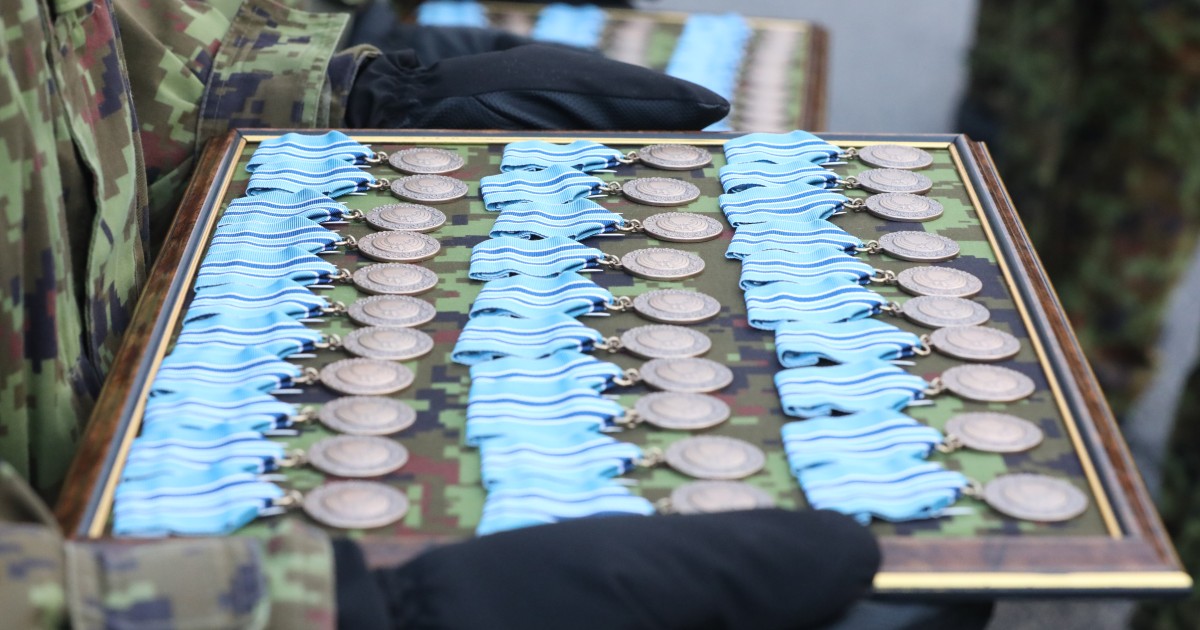
The Crosses of Merit and Breast Badges are awarded to officials of the Ministry of Defence as well as to Estonian and foreign citizens for their contributions to the development of Estonia’s national defence. These decorations are awarded by the Minister of Defence upon the proposal of the Ministry of Defence Decorations Council. As a rule, decorations are presented twice a year: on Estonia’s Independence Day (24 February) and on Victory Day (23 June).
The Medal for Participation in International Military Operations is awarded to Estonian service members who have taken part in international military operations and to foreign citizens who have contributed to the success of Estonian Defence Forces missions abroad. The medal is awarded by the Minister of Defence upon the proposal of the Commander of the Estonian Defence Forces.
The decision to award Ministry of Defence decorations is made by the Decorations Council of the Ministry of Defence, whose members are appointed by the Minister of Defence.
Ministry of Defence Cross of Merit
The Ministry of Defence Cross of Merit was established on 24 February 1998, on the occasion of the 80th anniversary of the Republic of Estonia, to recognise individuals who have rendered distinguished service in defending Estonia or in building and strengthening the country’s national defence system.
The Cross of Merit has three classes.
First Class Cross of Merit
The First Class Cross of Merit is awarded for exceptional contributions to the defence of the Republic of Estonia or to the development and strengthening of national defence.
Recipients of this distinction have included prominent Estonian and international figures who have made significant contributions to Estonia’s security and defence. Among the recipients are President Lennart Meri, Siim Kallas, Mart Laar, Jüri Luik, and Margus Kolga for their dedicated efforts in advancing Estonia’s integration with NATO.
The First Class Cross of Merit of the Ministry of Defence is worn around the neck and, when a neck decoration of a national order is worn, below that decoration.
Second Class Cross of Merit
The Second Class Cross of Merit is awarded for long-term and effective contributions to Estonia’s national defence.
Third Class Cross of Merit
The Third Class Cross of Merit is awarded for notable contributions to the development of Estonia’s national defence and may also be awarded to freedom fighters who played a significant role in restoring Estonia’s independence.
The Second and Third Class Crosses are worn on the left side of the chest, after Estonian state decorations and before foreign decorations unless otherwise specified.
The Ministry of Defence Badge was established on 4 May 1993 as a two-class decoration to recognise employees of the Ministry of Defence as well as Estonian and foreign citizens for their contributions to the development of Estonia’s national defence.
The badge is awarded to employees of the Ministry of Defence and to Estonian and foreign citizens for their contributions to the development of Estonia’s national defence within their respective fields of work.
First Class Badge
The First Class Badge, known as the Ministry of Defence Gold Badge, features the central element of the Ministry of Defence coat of arms – the small coat of arms of the Republic of Estonia placed on crossed swords behind a shield. The badge is made of gold-coloured metal with the lions of the coat of arms enamelled in blue.
For employees of the Ministry of Defence, eligibility for the Gold Badge generally requires at least ten years of impeccable service in the ministry.
Second Class Badge
The Second Class Badge, known as the Ministry of Defence Silver Badge, has the same design and dimensions as the Gold Badge. However, the swords are made of silver-coloured metal and the lions of the coat of arms are not enamelled but embossed in relief.
For employees of the Ministry of Defence, eligibility for the Silver Badge generally requires at least five years of impeccable service in the ministry.
The Medal for Participation in International Military Operations is awarded to Estonian service members who have participated in international military operations and to foreign citizens who have contributed to the success of these missions.
The medal may also be awarded, upon the proposal of the Ministry of Defence Decorations Council, to Estonian or foreign citizens for outstanding contributions or cooperation in international military operations and for support provided to Estonian military units.
Description of the Medal:
The medal is made of silver-coloured metal and has a diameter of 31 mm. On the front side, the medal depicts the map of Estonia on a globe, surrounded by olive branches and crowned with a compass rose.
The reverse side bears the inscription “In the Service of Peace.”
For each additional mission, a clasp with a number indicating the number of deployments is attached to the ribbon. The clasp is a silver-coloured plate measuring 6 mm by 34 mm, with the number displayed in relief. Individuals recognised for their outstanding role in preparing or supporting international operations may have a silver olive branch attached to the ribbon
.
The medal is worn on the left side of the chest, after Estonian and foreign state decorations and before other decorations.
Last updated: 09.09.2026